NEWS
The “Compost Day”: compost goes zero-mile too From the San Zeno plant, production of “neighbourhood” soil improver Compost also goes zero-mile: production of “neighbourhood” soil improver arrives, intended solely for local use in small towns, hamlets or districts. This will be discussed at…

The “Compost Day”: compost goes zero-mile too
From the San Zeno plant, production of “neighbourhood” soil improver
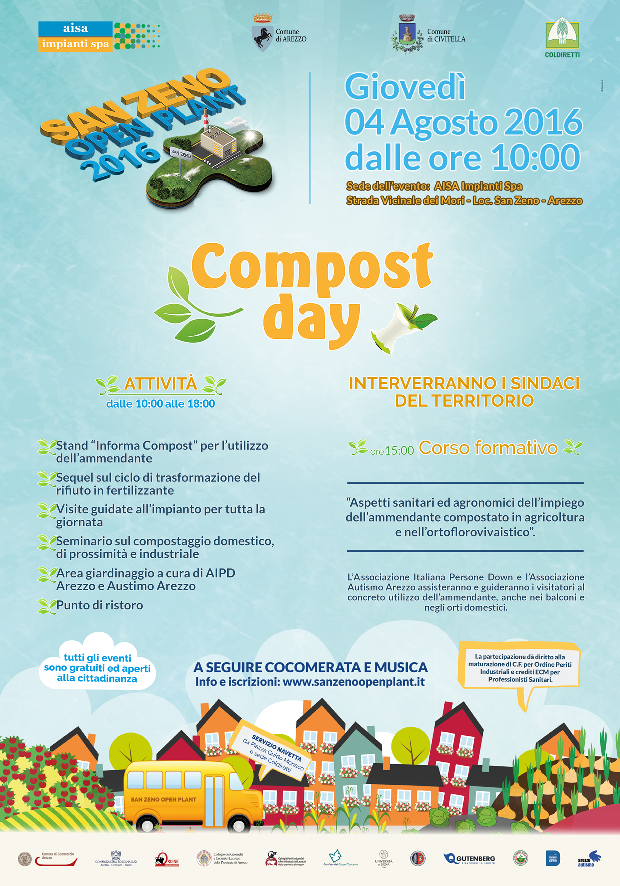
Compost also goes zero-mile: production of “neighbourhood” soil improver arrives, intended solely for local use in small towns, hamlets or districts. This will be discussed during the “Compost Day”, scheduled for Thursday 4 August from 10 am, when the Aisa plant at San Zeno will open its doors to citizens and environmental professionals for a day of meetings, a free course with training credits and an in-depth look at the new laws and the opportunities linked, precisely, to soil improver.
The Compost Day is organised by Aisa Impianti in collaboration with the Municipalities of Arezzo and Civitella in Val di Chiana and with Coldiretti. Available to the public throughout the day will be an Informacompost desk where an agronomist will answer doubts and questions about the qualities and characteristics of the soil improver, especially as permitted in organic farming like that produced by Aisa Impianti, and a Gardening Area where visitors will be shown how to use compost in practice in home growing, explaining the quantities and proportions of product to use to pot a geranium on the terrace at home.
Antonio Boncompagni, president of Aisa Impianti: “first of all, thanks to the Municipalities of Arezzo and Civitella. The day is designed above all as one of outreach and interaction with the citizens. The idea that needs to get across is that separate waste collection is, above all, collection of organic waste: in the province of Arezzo we have 200,000 tonnes of waste and if we intercepted all the organic waste we would reach 100,000, half. In short, 50% could be treated as such. Over time we would like to extend the use of the proximity soil improver produced by our plant; moving to the marketing phase is premature now but will have to be considered. The immediate usability of our soil improver is something we would like to make citizens aware of, and the event on 4 August goes in this direction. San Zeno has a waste-to-energy plant but 40% of the facility, which is not by chance called integrated, is devoted to composting and other aspects of the waste cycle”.
Mayor Alessandro Ghinelli: “we are facing a milestone on waste because we are seeing the final step of a treatment process, a product that had never before been brought to completion and that comes from our plant. It is not yet on the market but on 4 August citizens will be able to take home bags of organic product, ready to use, by making, if they wish, a donation to the associations Arezzo Autismo and Associazione Italiana Persone Down. San Zeno does not only produce incineration but quality soil improver at the end of a virtuous circuit: waste returns into the hands of citizens, in a different form, for a different use: it is in any case something ready to be used for agricultural or domestic purposes. A milestone also for adding one more piece to the progressive reduction of the Tari waste tax, which is our great objective”.
Marco Sacchetti, environment councillor of the Municipality of Arezzo: “our plan is to move closer to proximity-based processes for the collection and treatment of organic waste. This would remove a huge quantity of waste from the stream, cut treatment costs and, as a result, citizens' rates. This strategy of Aisa Impianti fits well with the administration's action and certainly does not run counter to the potential of the San Zeno plant”.
Concepts reiterated by Andrea Tavarnesi, environment councillor of the Municipality of Civitella in Val di Chiana: “household composters and neighbourhood composters can help on this path”.
Leonardo Belperio, vice-president of Coldiretti Toscana: “the product has only benefits for the environment and the territory; we consider it a starting point for arriving at a more structured production”.
During the morning, with free admission, there will be a succession of talks by agronomists, epidemiologists and sector experts, including the president of the Consorzio Italiano Compostatori, Alessandro Canovai, to illustrate, among other things, the innovations introduced by Law 221/2015 on the possibility of setting up composting close to the needs of small towns and areas with a predominantly agricultural vocation. The proceedings will be summed up by the mayor of Arezzo, Alessandro Ghinelli, the mayor of Civitella, Ginetta Menchetti, and the president of Coldiretti, Tulio Marcelli.
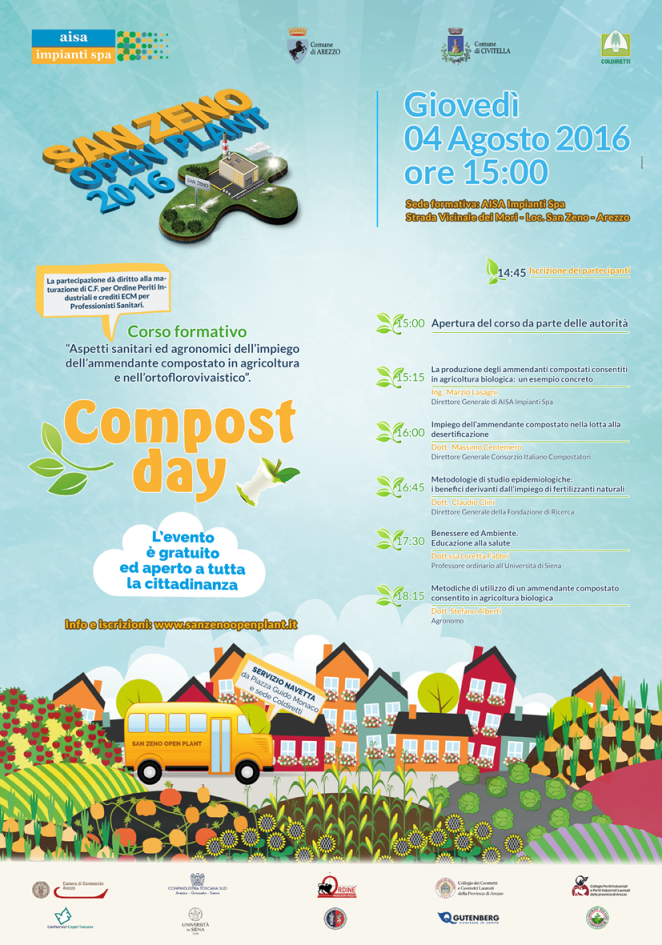
In the afternoon the conference room of the San Zeno plant will host the free training course “Health and agronomic aspects of the use of composted soil improver in agriculture and in horticulture and nursery growing”, open to all and aimed in particular at surveyors, technical experts, health personnel and agronomists, for whom training credits will be awarded. Speakers include Marzio Lasagni, general manager of Aisa Impianti, who will illustrate a concrete example of production of composted soil improvers permitted in organic farming, Massimo Centemero, general manager of the Consorzio Italiano Compostatori, who will speak about the use of compost in the fight against desertification, and Claudio Clini, general manager of the HBT Research Foundation, who will focus on epidemiological study methodologies and in particular on the benefits deriving from the use of natural fertilisers. The seminar will be closed by Loretta Fabbri, University of Siena, with a talk on health education, and Stefano Alberti, agronomist, on organic farming.