NEWS
green claims The “Zero Residue” label catches the consumer’s eye, but there is little awareness of the values and guarantees it offers This is what emerges from the Nomisma-AssoBio study presented during the conference “Beyond organic. Innovation, Trust and Sustainability for a New Relationship with the Consumer” at Marca 2025 Bologna, 15 January…

green claims
The “Zero Residue” label catches the consumer’s eye, but there is little awareness of the values and guarantees it offers
This is what emerges from the Nomisma-AssoBio study presented during the conference “Beyond organic. Innovation, Trust and Sustainability for a New Relationship with the Consumer” at Marca 2025
Bologna, 15 January 2025 – The organic mark remains synonymous with healthiness and sustainability; the latter is guaranteed by the presence of the organic mark but, to gauge the environmental impact of a food product, consumers increasingly also rely on on-pack claims relating to environmental attributes and the characteristics of production methods. There is therefore a growing need to give consumers greater awareness of the guarantees and values that the organic system offers and of the profound differences between organic certification and other green claims that are increasingly characterising what is on offer on the shelf. Among these, “Zero Residue” products generate strong interest among Italian consumers, despite low awareness of the distinctive elements and characteristics that this claim embodies.
These are some of the topics presented today by Nomisma at the conference organised in collaboration with AssoBio, entitled “Beyond organic – Innovation, Trust and Sustainability for a New Relationship with the Consumer”, held today in Bologna as part of Marca 2025 – the international private-label trade show at BolognaFiere. The event was held as part of the “Being Organic in EU” campaign, promoted by FederBio in collaboration with Naturland and co-financed by the European Union pursuant to EU Reg. No 1144/2014.
ITALIANS’ INTEREST IN ORGANIC PRODUCTS IS GROWING sghsh
In 2024 Nomisma recorded growing interest in organic products, to the point that at least one organic food product was purchased by 93% of the Italian population aged between 18 and 65 (equal to 24 million households). A great leap forward when one considers that only 12 years ago (2012) the percentage of the population inclined to buy at least one organic product was 50%.
LITTLE KNOWLEDGE OF THE “ZERO RESIDUE” LABEL
The Nomisma survey, carried out on a representative sample of the Italian population, shows that Italian consumers have little awareness of the guarantees offered by fresh or processed food products bearing the “Zero Residue” claim on the label: for example, 2 out of 3 consumers mistakenly believe that the production method linked to these foods does not involve the use of synthetic chemicals at all, a perception that is particularly widespread among those who do not consume organic products and, more generally, among those who do not know the differences between organic certification and the “Zero Residue” claim (50% of consumers are uninformed in this area).
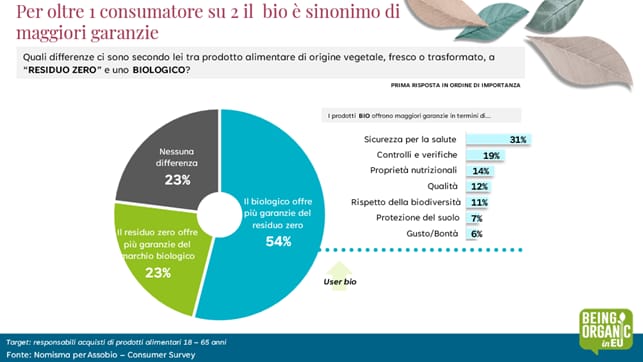
In this context, although the majority of Italians are perfectly aware of the greater guarantees offered by the organic mark (54%), there is still a 23% share of consumers who consider residue-free products to be entirely similar to organic products and a further 23% who even believe the guarantees offered by the claim to be superior to the certified organic production system.
 HOW ORGANIC PRODUCTS ARE PERCEIVED ON THE SHELF
Despite the information asymmetries surrounding the two different offerings on the shelf, on average consumers attribute a higher value to organic products than to those labelled Zero Residue from several points of view. On seeing an organic product on the shelf, 82% of consumers think of an environmentally sustainable product (against 77% for residue-free products), and 71% of production processes that exclude the use of synthetic chemicals to combat the main plant adversities (against 66%).
The greater guarantees recognised in the organic system translate into greater added value in terms of health safety, transparency in control processes along the supply chain (19%) and better nutritional properties of foods (14%).
There is therefore greater awareness of the values and guarantees of organic among the population than of the lesser-known “Zero Residue” (on which 50% feel they do not have clear information).
Among the pieces of information that most highlight and characterise the organic model in the perception of Italian consumers are: the sustainable production method and the commitment to protecting and safeguarding the soil (indicated by 79% of consumers among the main aspects they recognise in organic in terms of added value), the quality and traceability of products, guaranteed by the presence of a European certification (76%) and the absence of synthetic products, such as plant protection products and chemical fertilisers, cited by 73% of consumers.
“In a context that sees an exponential increase in green claims among the products on the shelf and growing interest in the sustainability characteristics of food products, organic shows strong resilience: most Italians recognise added value and greater guarantees in the presence of the organic mark compared with other wording/logos on the label. However, there is little awareness of the distinctive elements and characteristics of some of the main claims on the shelf, which in some cases risk downplaying the role of organic in the consumer’s perception” – said Silvia Zucconi, Chief Operating Officer of Nomisma.
“Today more than ever, it is essential to clarify green claims and the difference between organic and Zero Residue products, two categories that have completely different approaches and principles – said Maria Grazia Mammuccini, President of FederBio – Organic is the only form of agriculture certified by European regulations as a guarantee of sustainable practices that do not use synthetic chemicals and aim to increase soil fertility and biodiversity and to counter the climate crisis. The significant growth in the number of households that bought at least one organic product during the year, rising from 13 million in 2012 to 24 million in 2024, testifies to citizens’ great attention to food choices that respect environmental ecosystems, and who see organic certification as the highest expression of sustainability, despite sometimes misleading green claims. It is therefore necessary to invest in communication and information to raise awareness of, and convey, the values of organic. Valuable support is certainly provided by the Being Organic in EU project, the result of the collaboration between FederBio and Naturland, present at Marca to spread and consolidate knowledge of organic and the benefits it brings to people’s health and to the environment”.
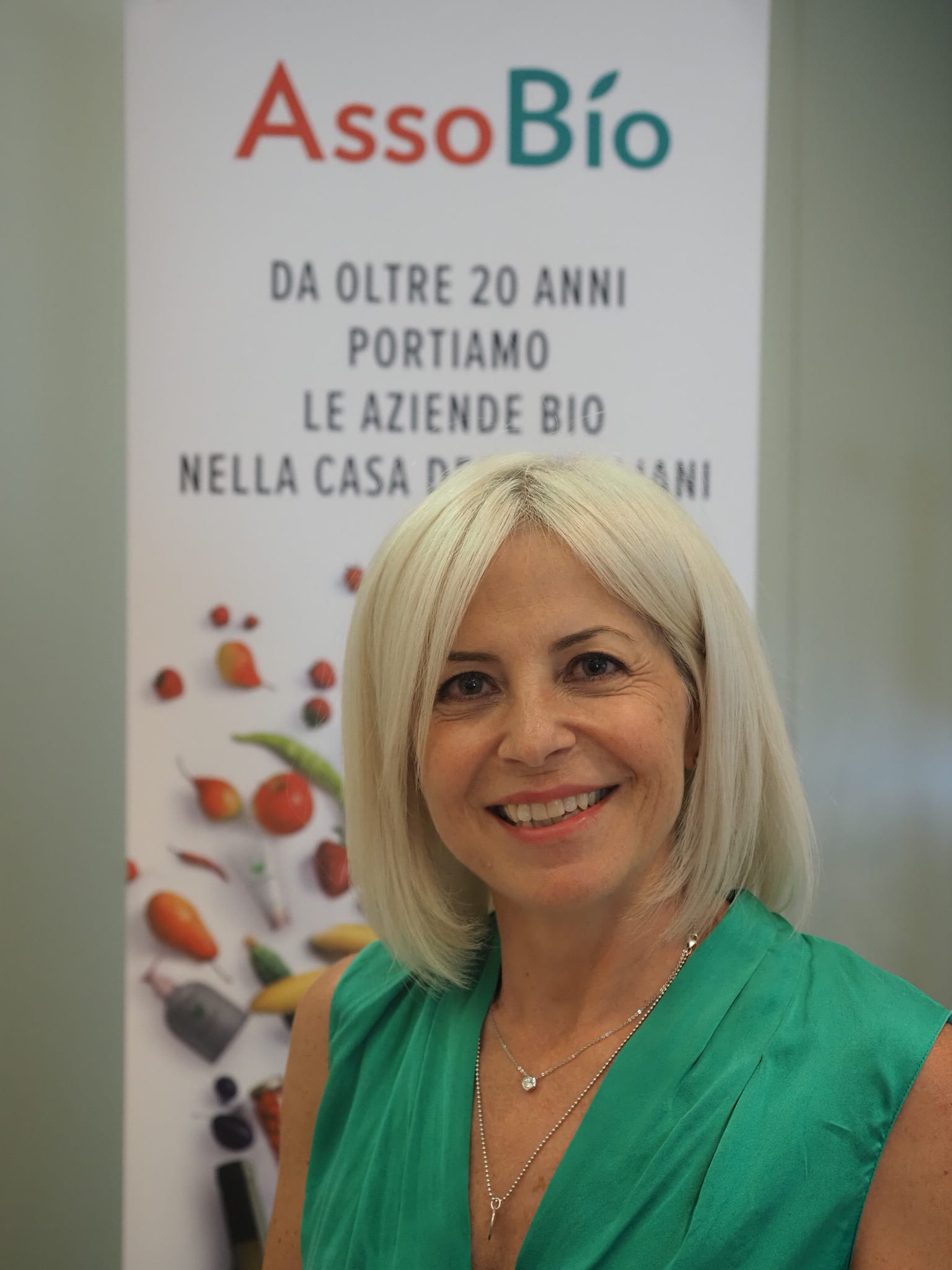 “The data presented today are very interesting and lead us to look ahead with optimism. Organic is growing in value and volume, as is citizens’ interest in taking care of themselves in the knowledge that food is health. We consider it essential – said Nicoletta Maffini, President of Assobio – to continue to spread the value and products of organic farming, the only solution for the health of our planet, of livestock and of humankind, and the important difference from “zero residue” products. Although sales figures are positive, we are still very far from the size this market has reached in the countries of Northern Europe; industry and retail have today agreed that we must act together to achieve this goal. As an association too, we will work to encourage collaboration among all the sectors involved and, last but not least, to raise further awareness among the Institutions so that they support the sector with concrete action.”
press release by Trefoloni e Associati