NEWS
AssoBio At Tuttofood 2025, an event to hear the export stories of the best quality producers and a new study on the consumption of Italian organic products abroad Bologna, 9 May 2025 – Passion, ideas, sales strategies, special products or classics of tradition: everything revolves around a single common denominator — the reliability and rigour of certifications…

AssoBio
At Tuttofood 2025, an event to hear the export stories of the best quality producers and a new study on the consumption of Italian organic products abroad
Bologna, 9 May 2025 – Passion, ideas, sales strategies, special products or classics of tradition: everything revolves around a single common denominator — the reliability and rigour of certifications. “Made in Italy”, inimitable and recognised all over the world, is appreciated above all because Italian organic production represents a standard of excellence. It is a sustainable model that promotes biodiversity, quality and a link with the land.
Today more than 20% of Italy’s agricultural area is farmed organically, and Italy is the European leader in the number of producers and processors. It is precisely this awareness — and this model — that was the focus of the conference “Il Bio Italiano che piace al mondo” (Italian organic products the world loves), organised by AssoBio and held on 7 May as part of Tuttofood 2025 – International Food Exhibition, taking place in Milan from 5 to 8 May, where the Association took part with a collective area dedicated to its members, who were present with their products and their stories.
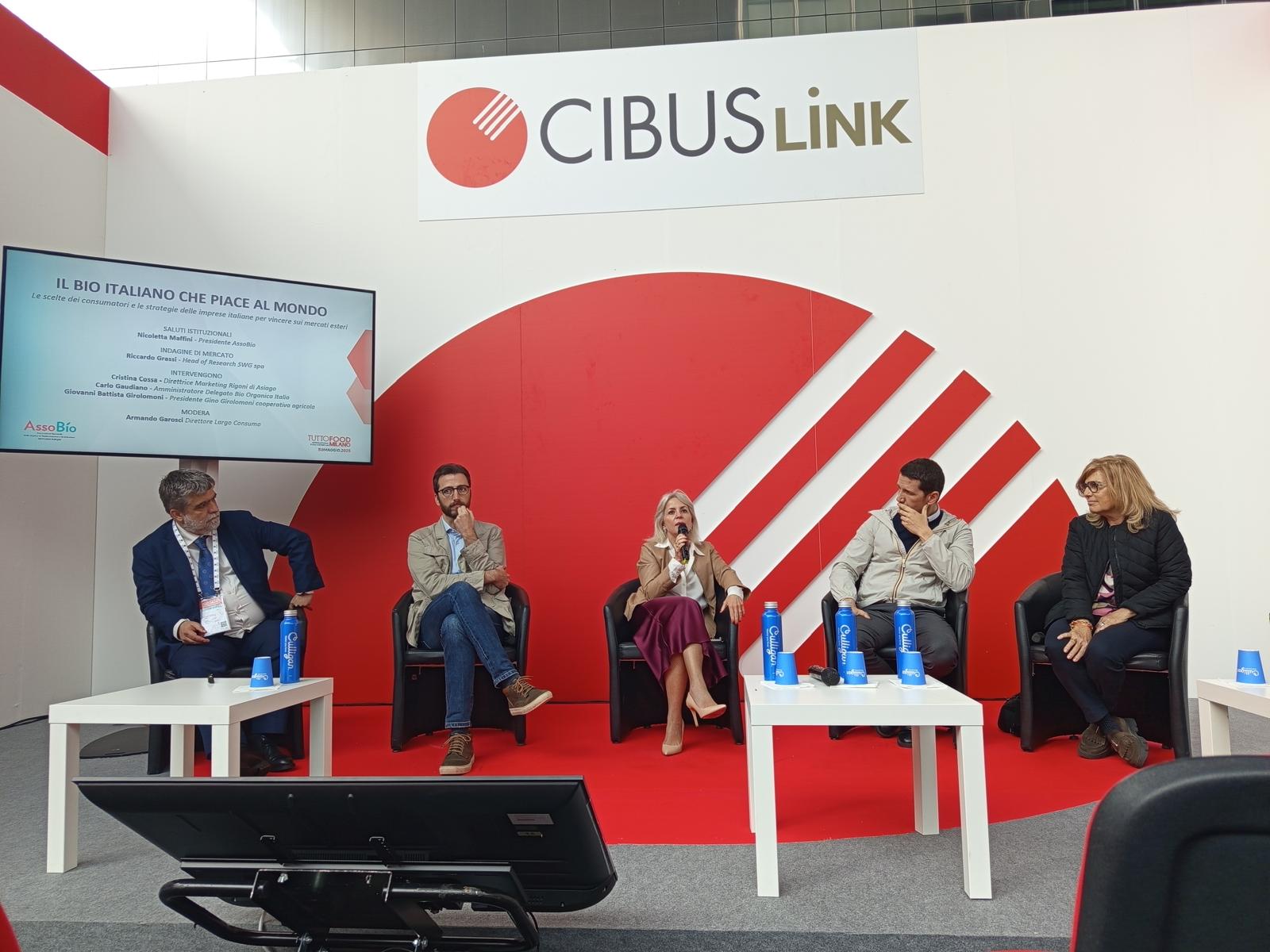
Three important company case histories, all Italian, took centre stage at Fieramilano Rho thanks to AssoBio members, who shared their experiences and successful strategies. Cristina Cossa – Marketing Director of Rigoni di Asiago –, Carlo Gaudiano – Chief Executive Officer of Bio Organica Italia – and Giovanni Battista Girolomoni – President of Gino Girolomoni cooperativa agricola, explained the factors behind the growth of Italian organic farming.
The talks addressed key topics such as the needs of international large-scale retail, strategies for striking an effective balance between production and distribution, consumer choices, and the actions taken by Italian companies to establish themselves in foreign markets. The reasons for the appreciation of Made in Italy organic products and their development prospects, including in new emerging geographical areas, emerged clearly.
“Production, marketing and distribution are our key words, but what truly sets us apart is a short supply chain, combined with the passion we put into every stage of the process – explained Carlo Gaudiano of Bio Organica Italia. This approach allows us to approach distributors with the guarantee of a supply chain controlled directly from the field, ensuring authentic and precise traceability. For the distributor, the advantages are clear: the first is the reduction of risk, because knowing where and how the product is grown is a guarantee of quality; the second concerns price, which is more competitive thanks to fewer intermediate steps. What we export, particularly to Germany, we call ‘organic 2.0’: organic that goes beyond traditional standards, with more advanced certifications. With Naturland certification, for the German market, we aim to reach a more mature and aware consumer. To obtain this certification, the company must also meet rigorous social requirements. The result is a product that not only excels in quality and sensory characteristics, but also respects ethical, social and biodiversity standards. It is a return to the roots of organic farming, inspired by the pioneers of this sector.”
Giovanni Battista Girolomoni, of Gino Girolomoni Cooperativa Agricola, recounts his own experience, starting from products that are by now a symbol of Made in Italy: “We were among the first to introduce organic wholewheat pasta and we had no difficulty establishing ourselves on the international market. The founder of our company used to recall that, even before European legislation came into force, some representatives of the United States Department of Agriculture had come to the Marche region to study our approach to organic farming and define the guidelines for the regulations. Today, however, a lot has changed: competition has increased and consumption has grown, so it is essential to identify the right consumers and channels. For example, in countries such as New Zealand our organic products are sold in gourmet shops specialising in Italian products, while in the United States we are present in “natural stores” that sell only products free from GMOs, preservatives or additives, where organic is seen as an ‘added value’. In Europe, by contrast, we mainly target organic specialist shops, where consumers are more loyal and aware: anyone who buys an organic product has already made a specific choice. Here we are quite strong in France, our leading market, which, together with Germany, accounts for 45% of our turnover. In today’s market it is essential to have distinctive features: organic alone is no longer enough, consumers today also look for a certified supply chain, sustainable packaging and, in markets such as France, themes such as fair trade or the sale of loose products. In France, for example, our loose-product market accounts for 35% of sales.”
“Italy is internationally recognised as a credible benchmark in organic farming, thanks to companies able to combine quality, taste and production integrity – explains Cristina Cossa of Rigoni di Asiago. However, it is up to each company to find the right approach to promote its products in different markets, adapting to the specific features of individual countries and the needs of local consumers. A crucial aspect is building solid relationships with local distributors, involving them in one’s own company. For this reason, we have always invited retailers – not only Italian ones, but above all foreign ones – to visit our company, the surrounding area and our production plants, allowing them to see our values and our commitment first-hand. This approach has allowed us to establish genuine partnerships and to identify the most promising product lines for each market. Thanks to this strategy, the share of turnover generated abroad has grown significantly in recent years, reaching almost 50%. Our main international market is France, where we now sell more Nocciolata than in any other country. We have been present in France for about 15 years and from the outset buyers appreciated our spread as a natural, organic, palm-oil-free alternative, in the face of what was then a limited offering on the shelf. This success was made possible by authentic storytelling, based on our values as a family-run company, rooted in the local area and passionate about quality. More recently, we are also achieving very positive results in Belgium, where we have just become the second player in the market. In the United States, by contrast, the path is more complex: organic alone is not enough and we had to obtain non-GMO certification to meet the expectations of local consumers. Despite a growing presence on the shelves, educating the American market still takes time and investment. Looking to the future, we are encouraged by the interest that emerging markets such as Eastern Europe, with Poland at the forefront, and the Middle East are showing in Italian organic products. I believe there is still ample room for Italian organic companies to conquer international markets, by showcasing quality, authenticity and innovation, without ever losing the link with their roots and their history.”
The conference also gave space to the data from the SWG research for AssoBio on the consumption of organic products in Europe, broken down into three macro-areas: Eastern Europe, Northern Europe and Southern Europe. In particular, the snapshot of purchasing choices and consumer perceptions in Italy, Germany, France and Spain provided useful insights for analysing one of the key issues for Italian organic products: domestic consumption that still needs to grow.
For 22% of European citizens, the choice of a product to buy is based mainly on the right value for money, while for 16% taste matters most. 13% are guided by the product’s appearance and 6% choose according to whether it comes from a sustainable supply chain or whether it is organic.
As regards purchasing channels, there is a clear preference for the supermarket when it comes to long-life products. By contrast, for fresh products consumers tend to favour more “local” channels, such as neighbourhood shops, markets and direct producers. This behaviour suggests that the fresher a product is, the greater the propensity to buy it from local businesses, a sign of growing interest in consuming locally sourced (zero-mile) products and in more conscious and sustainable purchasing choices.
Of particular relevance is respondents’ view of organic products, which reveals the need for greater information and clarity on the subject: for 76% of them all producers should use sustainable production methods, 75% say they find it hard to understand whether a product is actually organic, while 61% would like to buy organic but consider it an expensive product. Against this background, 49% of the European population do not trust organic certifications, while 41% consider organic merely a fad of the agrifood sector: attitudes that can be traced back to the heavy presence in the sector of logos and brands that describe themselves as “organic” and sustainable, amounting to greenwashing rather than environmental sustainability. There is, however, openness towards the organic world, given that 56% recognise the difference between organic and non-organic products and 58% say that, if they could, they would buy only organic products.
At the close of the conference, the president of AssoBio, Nicoletta Maffini, highlighted some of the aspects that make the organic sector truly unique. “Direct contact with nature and awareness of what lies behind the product leave an indelible mark on those who work in this sector. A further added value of organic is its ability to grow thanks to a family-like dimension that deeply involves employees, giving them a sense of participation that is often missing in very large companies. The choice to go organic is a choice of vision, which pays off with an authentic account of what one does and is: storytelling in organic is the story of a real business. I firmly believe that, in all our companies and in the organic brands established around the world, employees’ passion has been fundamental. Organic is not just a product, it is a commitment to the future, a concept that goes beyond questions of profit. Organic does much more, and that is exactly what makes us proud.
ASSOBIO PRESS OFFICE
Marta Franceschini – Trefoloni e Associati | [email protected]
Simona Bruno – AssoBio Marketing and Communications | [email protected]