NEWS
De-centralized banking: Monday 10 March, Aula d’Onore, 5.30 pm, Saa-School of Management, University of Turin Turin Turin. What if only a conflict, or a new major financial crisis and a default, could make us understand that the world is insolvent and should liquidate its real assets, property, land, oceans, mineral resources to get back in the black?…
De-centralized banking:
Monday 10 March
Aula d’Onore, 5.30 pm
Saa-School of Management, University of Turin
Turin
 Turin. What if only a conflict, or a new major financial crisis and a default, could make us understand that the world is insolvent and should liquidate its real assets, property, land, oceans, mineral resources to get back in the black? And to whom could it sell them? Global finance has powerful tools, but the planetary debt, certified at 313 trillion dollars in 2023, the financial derivatives circulating on the markets, scarcely regulated, worth 620 trillion, and a capitalisation of all the world's stock exchanges of "only" 109 trillion, show that global finance is not solid, and that its "virtuality" and digitalisation are not only constantly evolving but need to be fully understood in order to constitute a valid and effective alternative.
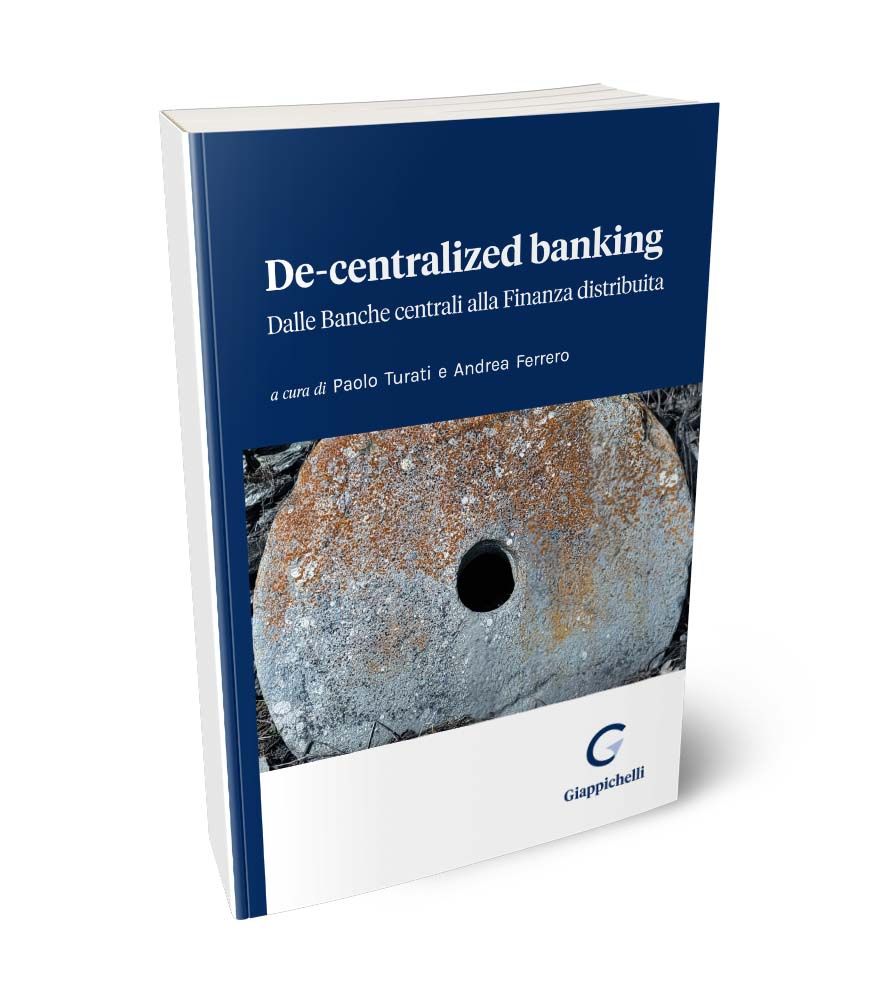
This is why De-centralized banking – Dalle Banche centrali alla Finanza distribuita, (Giappichelli, 192 pp.), the essay edited by Paolo Turati and Andrea Ferrero, a digital banker and an economist, clearly addresses the evolution of decentralised and distributed finance, investigating its strength, innovation, risks, performance and, above all, its future. Starting from its terminology and its latest frontiers.
This is how the book, published by Giappichelli, came about. It is aimed at financial operators, university lecturers, members of the economic and legal professions and investors interested in digital assets allocation in the fields of Blockchain, Tokenomics and decentralised finance. Giappichelli, an Italian publishing house founded in 1921, is a point of reference in the legal, economic and political science sectors and for almost a century has supported students, lecturers and professionals with materials and resources for academic and professional success, focusing on knowledge and human relationships to help millions of people achieve their aspirations.
The scenario of the analysis is the year of the all-time record reached by the price of the most famous cryptocurrency, Bitcoin, fifteen years since the creation of its eponymous Blockchain, and ten since the founding of its main competitor, Ethereum. The institutionalisation of Bitcoin and the dynamics of its revaluation, which have made it the best-performing financial asset of the last decade, suggested to the authors the need to explore, including from the technical and cryptographic point of view, a broader area of knowledge, which now necessarily includes NFTs, Metaverses and Artificial Intelligence, whose "fundamentals" are often too little known.
There are two sections, each written by its respective author. The first deals with "millennial" finance, the concept of decentralisation, blockchain and decentralised finance, neobanks, the various cryptocurrencies, fungible and non-fungible tokens (works of art, for example), the implications of AI, and taxation of investments in digital assets.
“Digital Decentralised Finance is the second attempt in a thousand years to respond to the overwhelming power of the centralised finance of Nations which, in a state of constant and massive conflict of interest, has generated centres of power that answer only to themselves, with the risk of creating immense damage that can only be verified after the fact, like that of the Great Financial Crisis that began in 2008 and is by no means yet resolved. The Orders of Knighthood that had attempted the first financial decentralisation were swept away manu militari by the Kingdoms of the time because they lacked an invincible weapon, namely the technology of digital networks, which today is instead in everyone's hands. Given that Progress can be slowed but not stopped, it is more than likely that the financial decentralisation of the 21st century is here to stay and is destined to play an important co-starring role in the global financial arena.”- explains the economist Paolo Turati.
The second deals with the operation of de-centralized banking, the role of the banker, from centralised to de-centralised, the players, technical insights into cryptography and tokenisation, custody activity, lending & borrowing, payment systems & currency exchange and investments in centralised and decentralised finance.
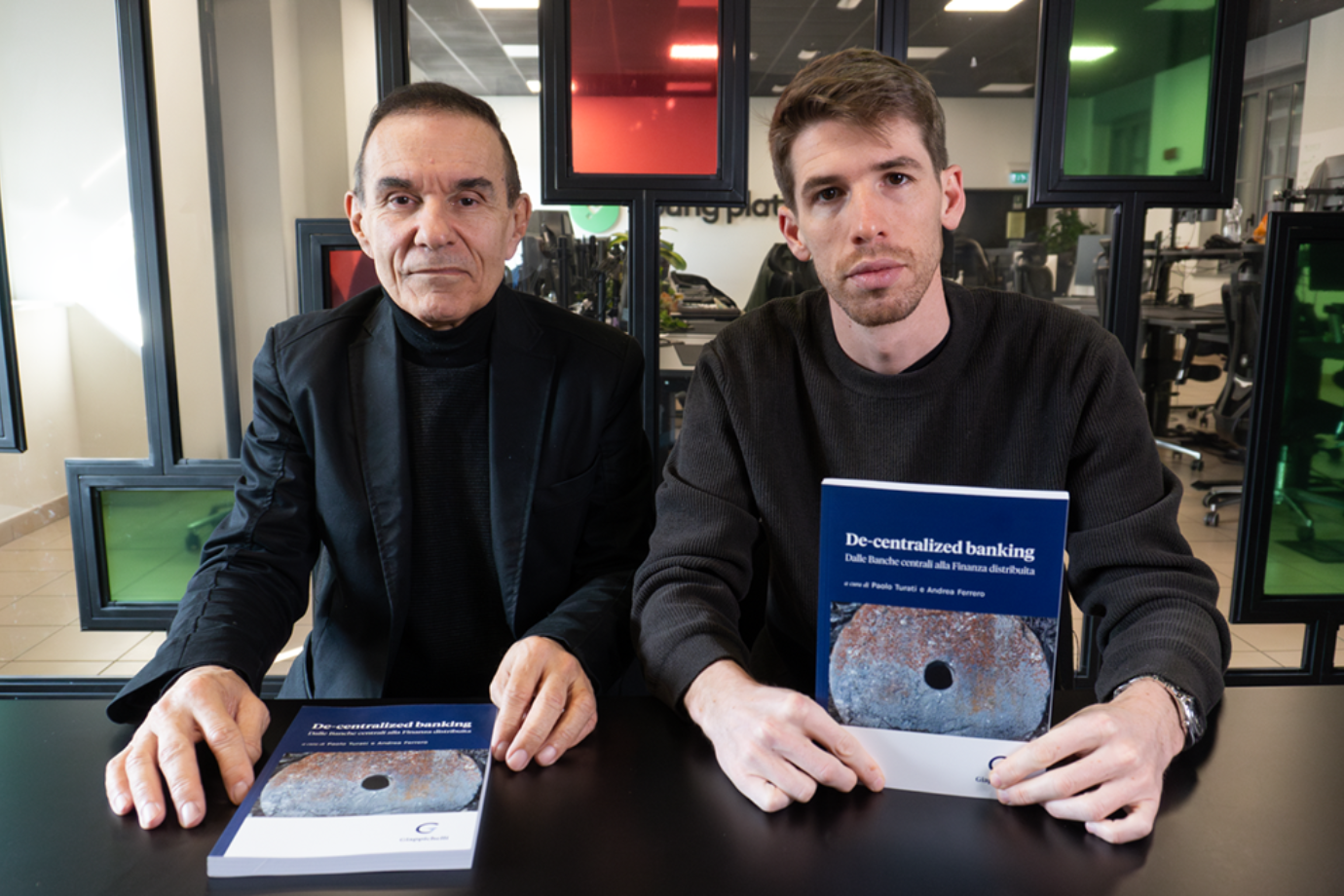
“The second part of the book is a guide to understanding the future of finance, where technology and decentralisation are redefining the rules of the game. From crypto-banks to decentralised platforms, we offer a clear vision of an increasingly autonomous, accessible and decentralised financial system, ready to transform the way we create and exchange value – says Andrea Ferrero, CEO of Young Platform – The book, aimed at 14,000 financial advisers, will be a reference text for the new specialist UIS certification that Efpa-Italia has decided to introduce this year, which is commendable since no certifying body had ever addressed the subject in the past”. – Ferrero concludes.
Andrea Ferrero, from Piedmont, born in 1997, a lifelong technology enthusiast, founded Young Platform in 2018 while studying computer science at the University of Turin. It is a startup whose goal is to make cryptocurrencies accessible to everyone, and it has become the leading point of reference in the cryptocurrency landscape with more than 2.5 million users. An expert in Fintech, Blockchain and Crypto, he works actively with media and stakeholders, speaks at the main industry events and takes part as a mentor in masters and workshops at leading Italian universities.
Paolo Turati. An economist, he is lecturer, coordinator and chair of the “E.M. Wealth Management A&I(ESG)” course at the Saa-School of Management of the University of Turin, where he also directs the Decentralised Finance and Blockchain Laboratory “LabDec”, the first of its kind to be established in Italy in an academic setting. A former director of securities brokerage firms and general attorney of a stockbroker, he is scientific adviser to Efpa-Italia, scientific manager of CryptoLeges and head of the "Banks and Finance" area of the consumer association Acp-Aps. A columnist for numerous national and international newspapers, and a scholar of Art Economics and of the historiography of art and the ancient world, he has written numerous essays, in particular on the global art market.